In August, we wrote about the missing crossing of the ION tracks from Traynor Ave to Fairway Ave in Kitchener. Without a pedestrian crossing, it means over a kilometre between crossings, and many residents are now cut off from services that used to be a walkable distance away.
Thanks to the help of the neighbourhood community, the issue made it on to the municipal radar, and the City of Kitchener recently had a public feedback session seeking feedback for a proposed crossing of the ION tracks. See the display boards here.
Read on for some analysis of what’s good, what’s bad, an analysis of how it will impact trips compared to before, and whether a crossing further west at 652 Fairway Rd (Fresh Burrito) might be better. (more…)
Last week, we talked about the gap in transit planning around ION and the 202 University Avenue iXpress. Click here to read the details. The Waterloo Region Record has also published a story, and we’ll be on CBC radio Tuesday morning at 7:40 to discuss it.
How can you help ensure that connections are in place for ION and GRT iXpress buses on University Avenue in time for 2018?
Give GRT your feedback! Follow that link to learn about the UW transit plaza and find a link to submit your feedback. Tell GRT you want them to live up to their key priority of building seamless connections to ION light rail.
Tell the University of Waterloo what you think. Contact the president’s office and explain that UW needs to step up and help our community get maximum value for our transit money, rather than obstructing good transit access to ION. Let the 202 pass!
Student or alumnus of UW? Contact the UW Feds and tell them you want the University to work with GRT, not against them, in order to make your own transit experience along University Avenue better.
Grand River Transit is investing in a new transit plaza next to the University of Waterloo’s ION station. But they have no stated plan to connect the 202 University iXpress with this location. In fact, they propose to have the 202 drive over the tracks and not stop near ION at all. How could this be? See the plans yourself, and then tell GRT you want the 202 to connect with ION.
Imagine that it’s early 2018, and ION has begun service. A young woman leaves her home in the Beechwood neighbourhood bound for work. Instead of getting in the car as she normally would, she walks towards the closest bus stop. Today she will find out if ION works for her.
It’s a short walk to the bus shelter, and a short wait for her bus to arrive: a 202 University iXpress. It quickly carries her along Erb to University Avenue, then through campus and she steps off the bus just metres away from the ION platform. It’s a quick and convenient transfer as the train glides smoothly into the station as she walks up and just like that, she’s on her way downtown.
Now imagine instead, her bus drives right past the University of Waterloo. There’s the unmistakable thump-thump of crossing railway tracks: surely, this must be the place to transfer. But no, the bus keeps going.
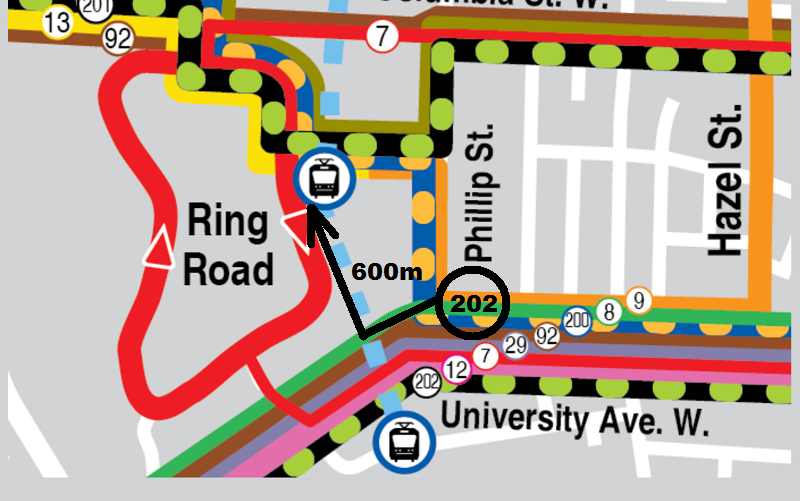
She gets out at the very next stop, beyond Phillip St. She doesn’t know the area, and she can’t see the station anywhere around here. She asks a passing student, who points back towards the tracks. She starts walking.
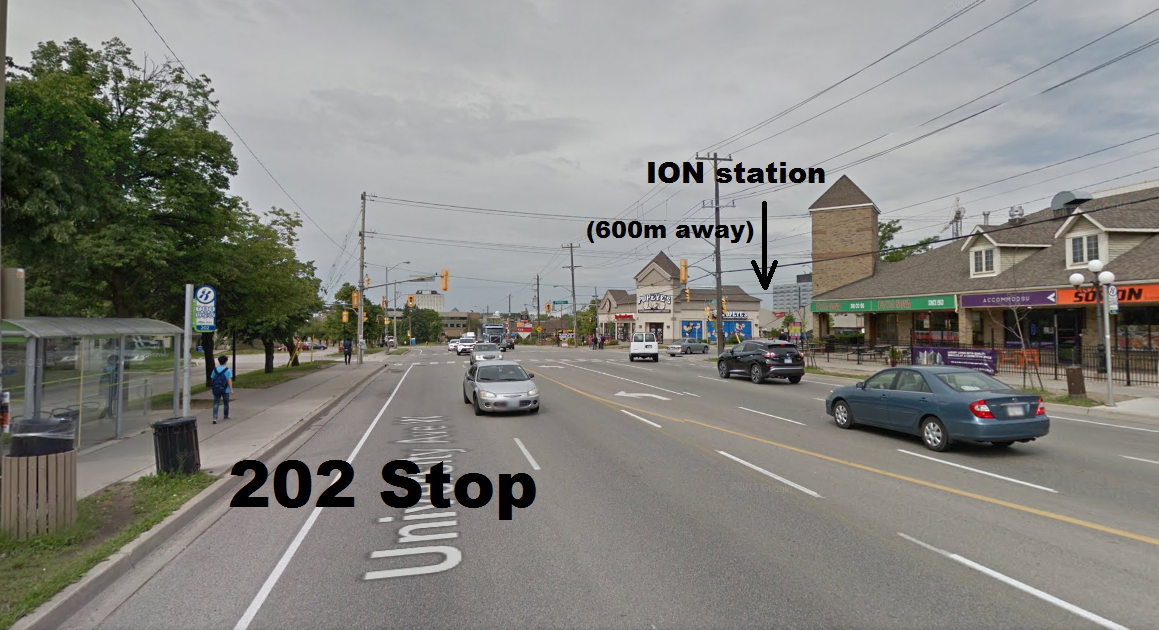
Despite crossing each other, the 202 and ION stops are a long way apart.
It’s almost 10 minutes before she has found her way to the ION station. By now, she’s cold and annoyed. These iXpress buses were supposed to connect seamlessly with the train, she thinks. Do they actually expect her to walk all this way every time to catch her train downtown, and then find her way back to this bus stop in the evening? Why does her bus completely bypass the light rail line whose tracks it drives over? She can’t understand why anyone would think this was a good idea. She resolves to go back to driving tomorrow.
Of all these routes, the 202 is the most vital to connect with ION.
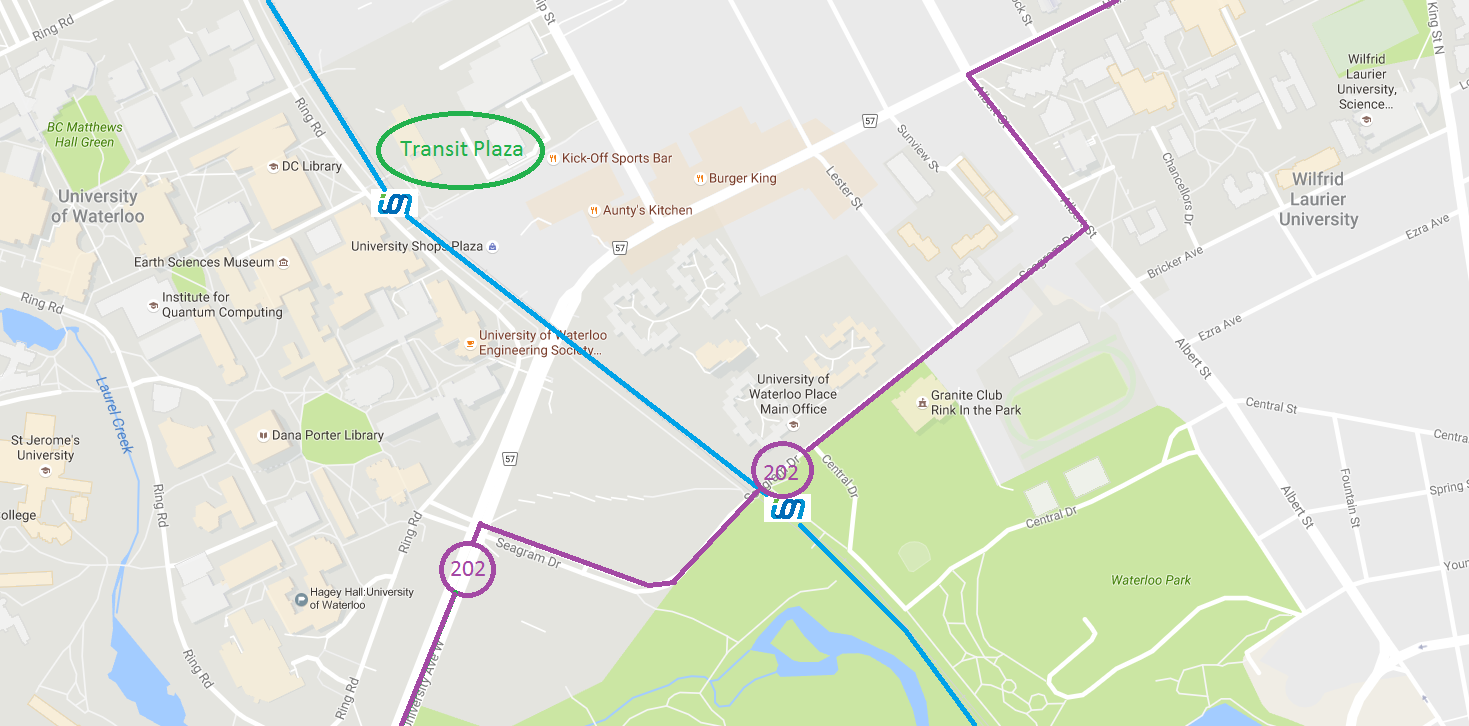
Sadly, it is this latter scenario that we are being set up for. GRT revealed its plans for the new UW transit plaza and route adjustments in the area to connect here, and those plans specifically exclude the 202 University iXpress. Despite the creation of this plaza and the placement of the UW ION station, the University of Waterloo wants to block bus access to sections of Ring Road. The 202, serving our region’s second largest transit corridor, is a casualty of this decision, currently relegated to bypass ION and stop a long distance away.
The 202 is Waterloo’s best cross-town route, extending to Erb West and University East.
But there are alternatives. There are ways to make this work. Unfortunately, Grand River Transit appears to be proposing inaction when they presented to the public last week. The vision of iXpress cross-town lines feeding the ION transit spine may well be abandoned where it is most critical.
We must ensure that this connection happens. GRT needs to step up, and deliver a solution. And if GRT can’t bring the 202 to the UW transit plaza, then it should instead be routed to connect with ION at the Laurier-Waterloo Park station on Seagram drive.
Why not connect 202 with ION on Seagram, and also provide Laurier with an ION shuttle at the same time?
Making these connections between ION and iXpress is of paramount importance to ensuring that our investment in LRT benefits more than those who live and work immediately adjacent to the line, because they connect ION riders to many more destinations outside the central transit corridor.
It’s not too late to tell GRT directly that you want to see the 202 iXpress bring you to ION’s doorstep. You can see GRT’s plans yourself, and submit your comments online. Let’s help our transit planners make the connection.
What’s in store for GRT? As we prepare for the arrival of ION, the region’s Transit Services has given us a glimpse into the next few years of Grand River Transit. Here at TriTAG, there’s nothing we like more than a thick PDF full of juicy planning details. We dive into the Interim Report on GRT’s 2017-2021 business plan so you don’t have to!
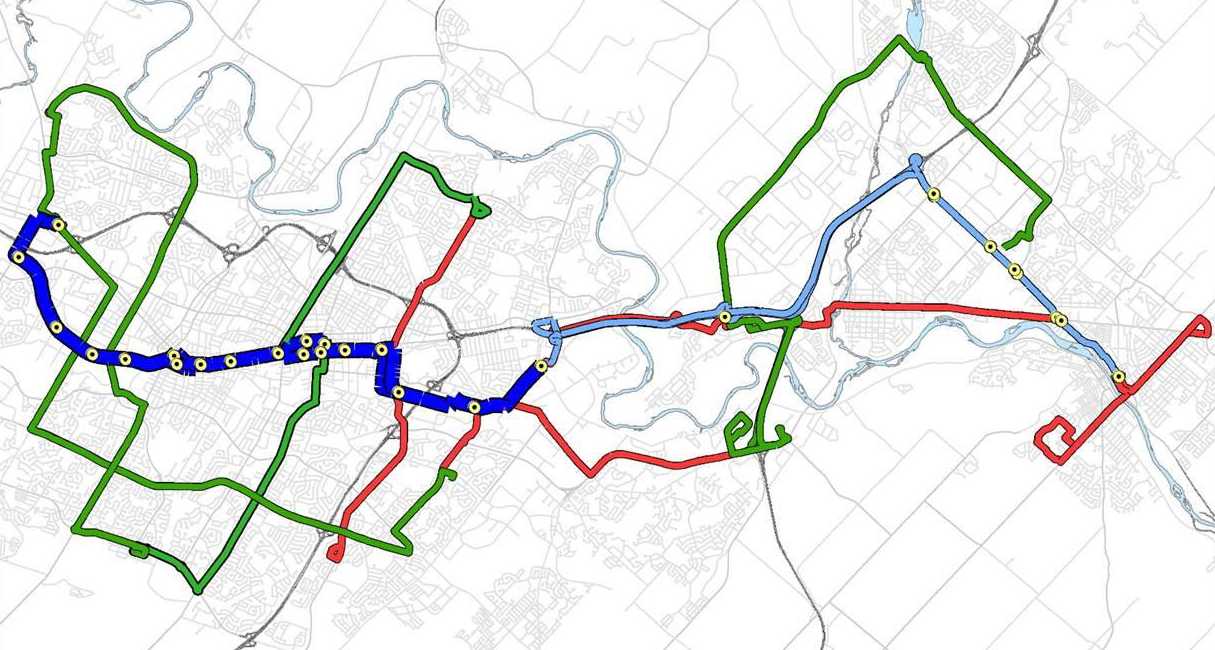
Obviously, ION’s launch in early 2018 represents a major change for our region. With ION light rail providing a fast, reliable backbone for transit trips across a single fare, integrated transit network, the bus system needs some changes to take advantage of this. In addition, plans are afoot to continue growing the iXpress bus network:
New 205 Ottawa iXpress (Sept 2017)
10 minute peak frequency on 201 and 202 (Sept 2017)
Extension of 201 to Block Line ION (early 2018) and then on to Conestoga College (late 2018)
You should expect to see some major changes to other bus routes in the wake of ION, as well:
Launch of the UW Transit Plaza (Sept 2017) for routes 9, 13, 31 and 201. (But not 202?)
Also look for service frequency improvements a number of routes, as well as possible expansion to serve new suburbs and some townships.
Some of the changes proposed by GRT for 2017.
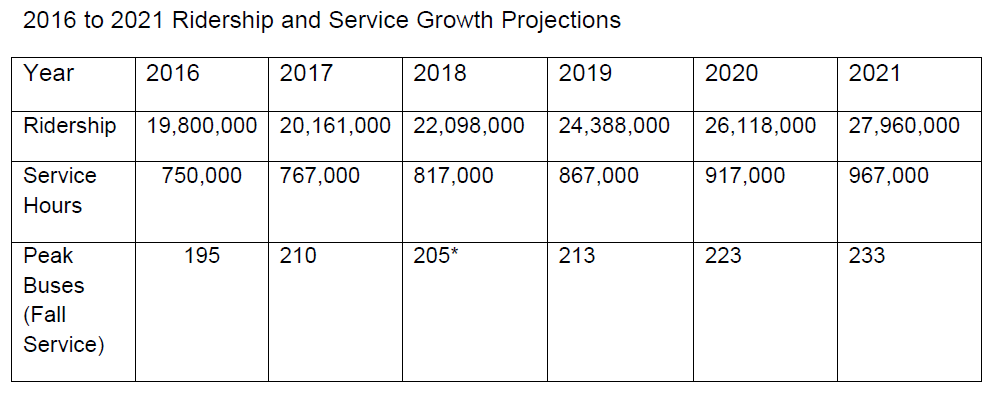
Underlying all of this is a strong growth target being set. After over a decade of skyrocketing ridership, 2014 and 2015 saw a decrease in the number of riders. Planners blame this on a loss of school board funded high school trips, the disruption of ION construction, and also on years of unrelenting fare increases that GRT has been directed to undertake.
However, region staff expect ridership growth to bounce back and then some. Serving just under 20 million rides a year right now, the plan is to reach 28 million in just 5 years!
This will take some doing. For one, ION will need to live up to its expectations. But the real question is whether our regional council is ready to make the investment in transit that this requires. This means committing to funding the expanded service hours (29% over 5 years) and to stop driving away riders– in particular, the new riders GRT seeks– with continuous fare hikes well above inflation.
Regional government must commit to supporting ridership growth to hit these projections.
There’s more in this report that catches our eye, but only so much we can go into in one post. Do the proposed route restructures make sense? Is GRT being too cautious and incremental in its redesign to meet lofty ridership goals? And is there an overemphasis on peak service frequency at the expense of all day flexibility?
We’d like to delve deeper into these questions. Watch this space.
Thursday, September 22, 2016
Drop in anytime between 5 – 8 p.m.
Lions Arena 20 Rittenhouse Road, Kitchener
GRT Routes 3, 12, 22 and 201 iXpress
Thursday, September 29, 2016
Drop in anytime between 5 – 8 p.m.
Waterloo Memorial Recreation Centre,
2nd Floor, Hauser Haus 101 Father David Bauer Drive, Waterloo
GRT Routes 5, 8, 12 and 200 iXpress
ION light rail, well under construction, is going to tie our region together, promoting dense, walkable communities around each new station.
We may remember the panic at the thought of a “Berlin Wall” being erected through Waterloo Park. Cutting the park in two, and separating the sides. While we may have a fence after all, it is proving not to be a barrier at all, as plentiful crossings of the rail corridor at Father David Bauer and Central Dr keep the sides connected. When ION opens, it will be just as easy to get from one side of Waterloo Park to the other as was before.
However, while all eyes were turned to Waterloo Park, it turns out another part of town was going to be cut in two.
The Traynor-Vanier Neighbourhood
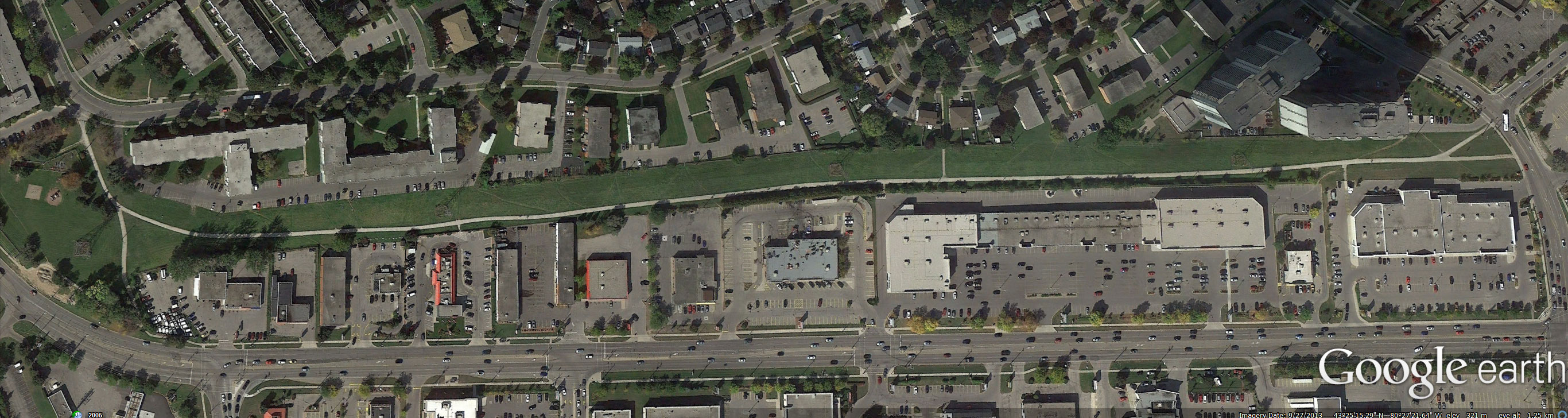
The Traynor Ave neighbourhood lies just north of the Hydro right-of-way that divides it from the businesses on Fairway Rd. “Divide” in this case, is a rather strong term. In fact, there are dozens of formal and informal paths connecting this neighbourhood to the dozens of retail businesses on Fairway. Restaurants, fast food, groceries, services, clothes, housewares, and much more are all accessible to this neighbourhood by a short walk on foot.
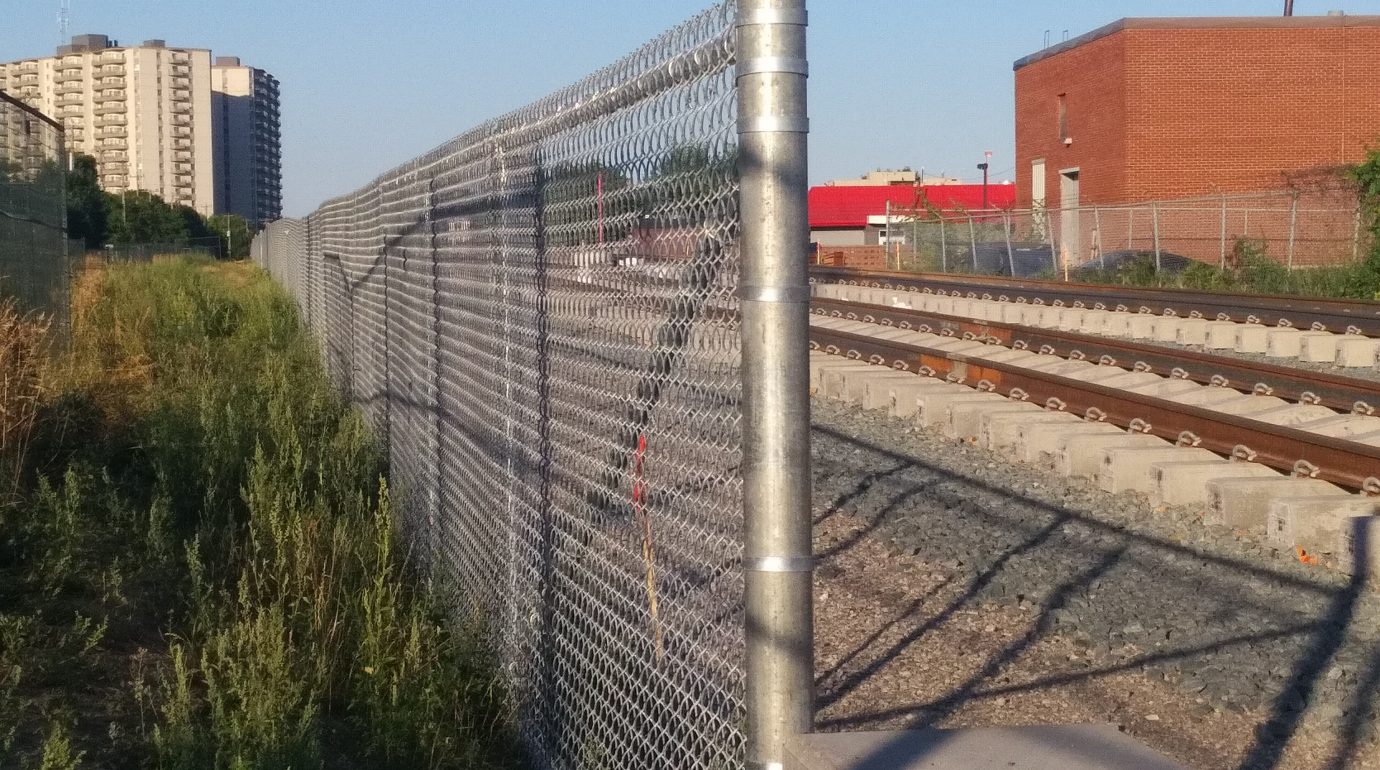
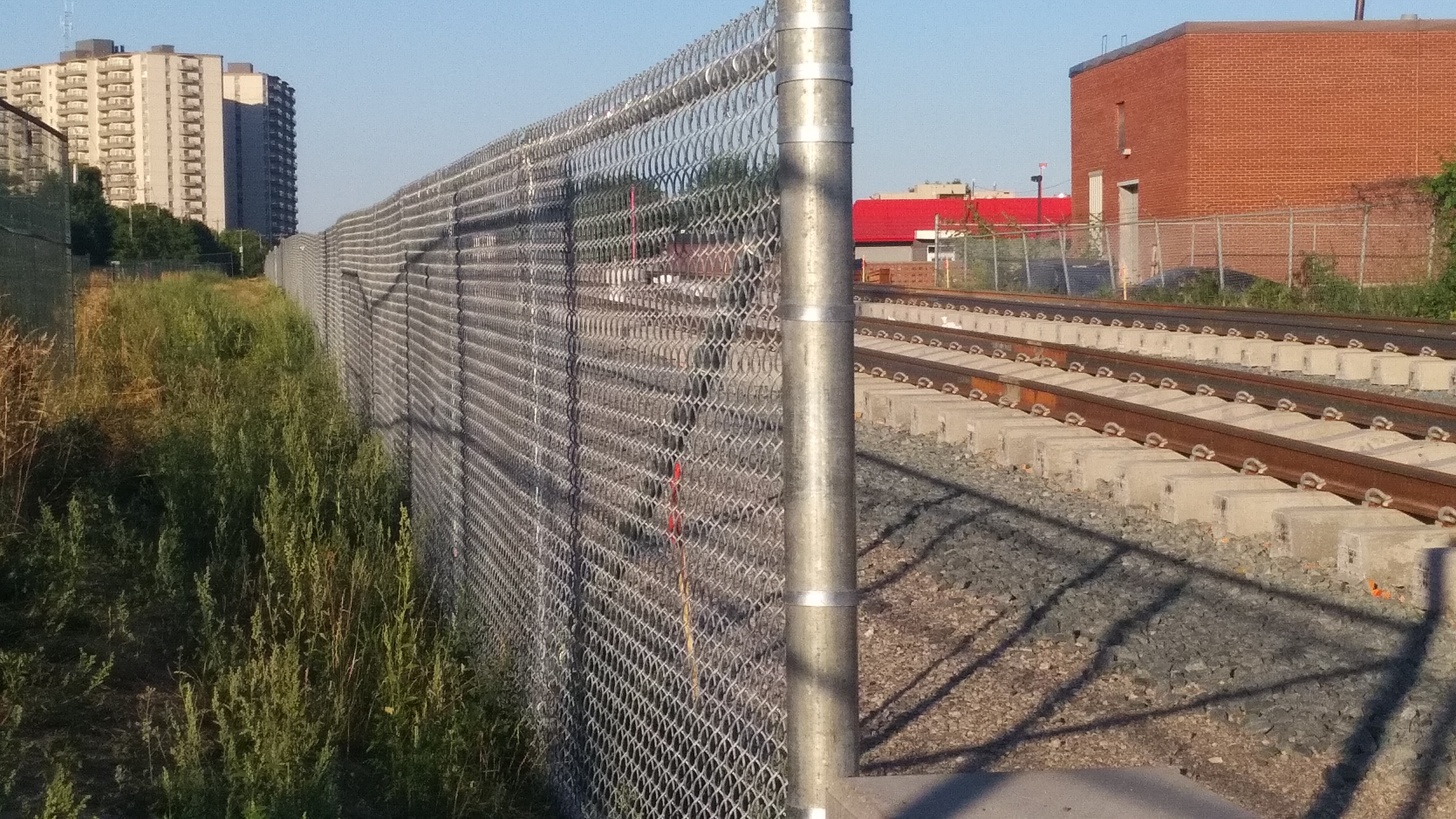
Over the past month, installation of a fence next to the tracks began, sparking shock and surprise among locals. The Rapid Transit team has since confirmed that there are no planned pedestrian crossings between Courtland Ave and Wilson Rd, a distance of 1 km. What was once a 100m walk for Swiss Chalet is now to be a 1100m hike. Residents have now started a petition asking for a crossing to be reinstated.
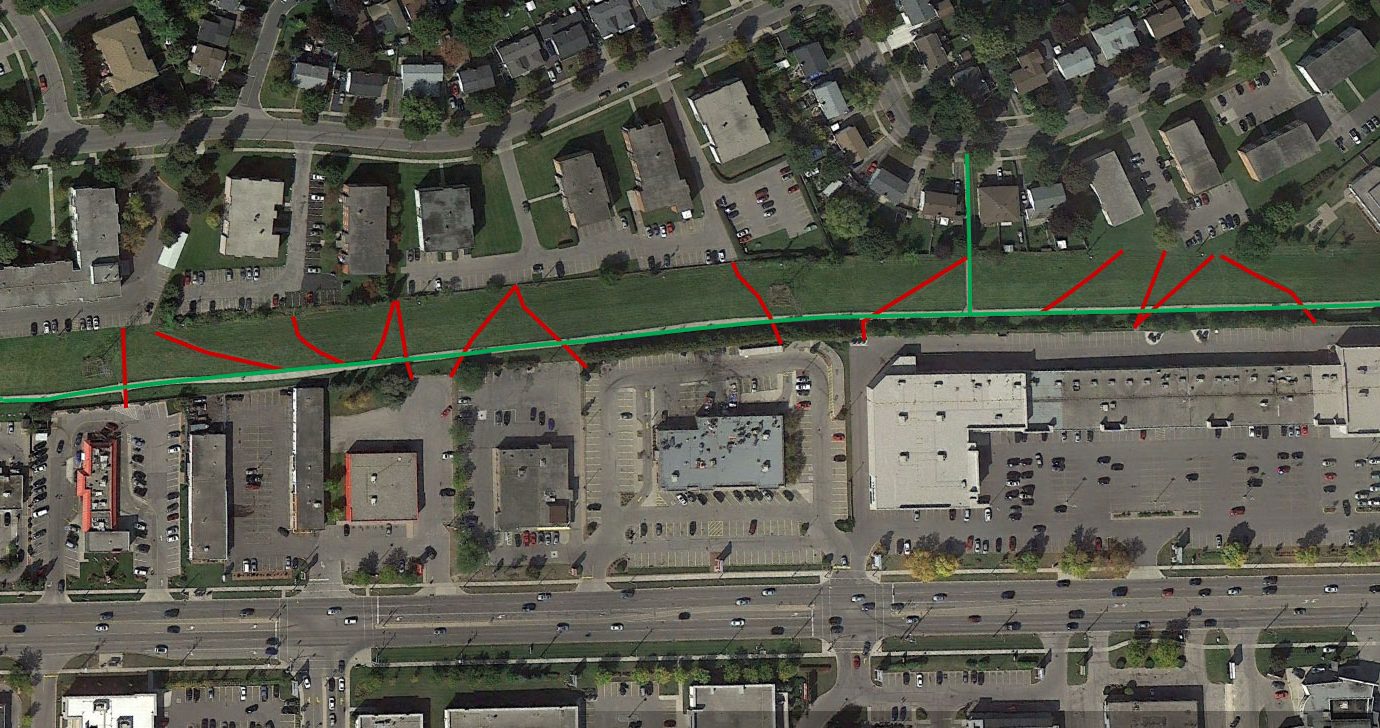
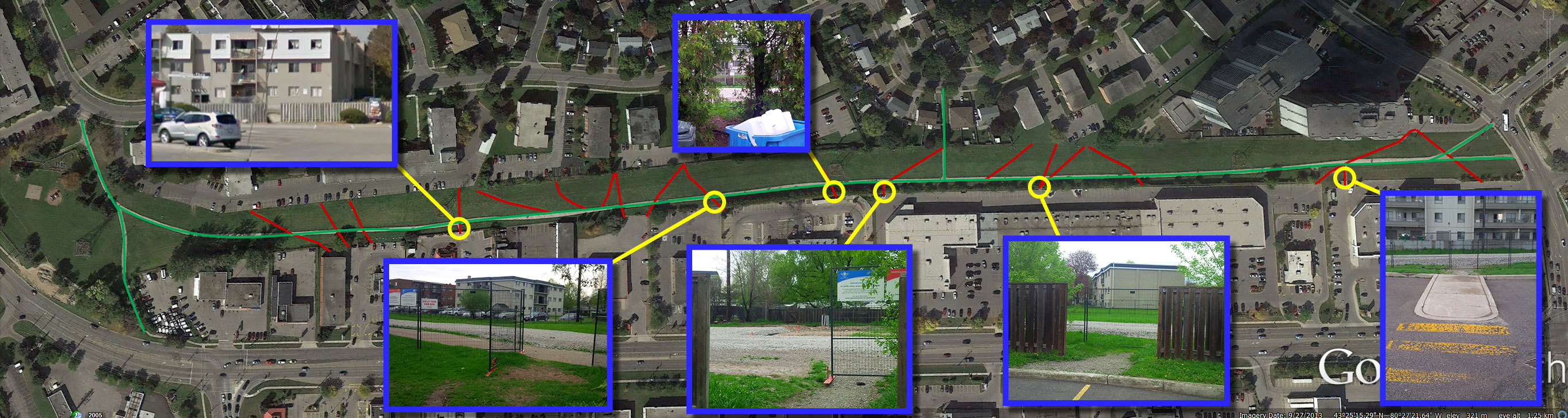
Before construction began, there were dozens of paths connecting residents to the businesses. Here they are highlighted in red with some close ups:
Formal paths in green. Informal paths in red. Selected crossings shown with inset photos
These are not simply informal holes cut in fences. Most of these paths have even been legitimized by the businesses that they open on to. Fences have been properly framed to allow crossing. Other properties have never even bothered to install a fence, allowing customers free access.
Unintended Consequences
Much has been made of ION Light Rail’s ability to help make Waterloo Region a more walkable community. However here, we see a community that was already walkable, have their access removed. It’s unreasonable to expect residents to walk the 1km detour being imposed upon them, and this will directly lead to more trips by car. The exact opposite of the goals of Rapid Transit.
Residents crossing the LRT tracks through incomplete fences.
The residents of the Traynor neighbourhood already see little positive impact from LRT. They are at the midpoint of the second longest stretch of track between stations in the entire system. The line goes through their literal backyards without stopping. Now, to add insult to injury, LRT has cut them off from their own neighbourhood stores.
Not Too Late For Change
The good news is that it’s not too late to change this. There are 18 months still to go before ION’s opening day in 2018. The issue now has the attention of regional councillors. Whether a change is worked out with GrandLinq, or the Region does the work on their own after initial construction finishes in 2017, there is still time to fix this before it requires interrupting ION service.
There will be a cost to put this right, but the purpose of ION is to connect us, not to divide. Let the Region of Waterloo, and the City of Kitchener know about the importance of this connection by signing the petition, and speaking to your councillors.
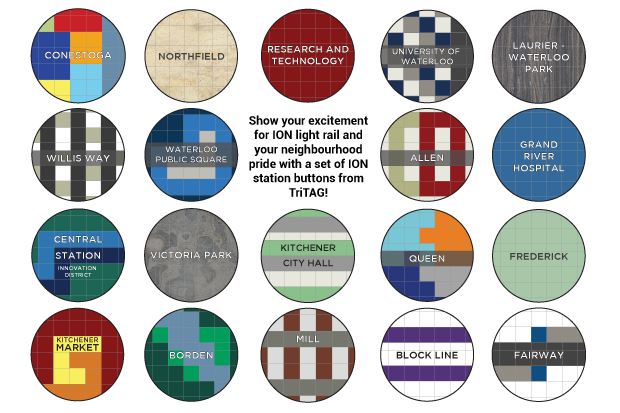
Update: ION station buttons are now available from our online store!
Show your support for light rail and your neighbourhood pride
You’ve seen the construction, the tracks getting put in the ground, the stations falling into place.
At TriTAG, we’re excited to soon be able to get around town with rapid, frequent transit service. For the last six years, we’ve been advocating for more transit, protected bikeways, and better walking conditions to our cities to make our communities great places to work and live.
We want you to share your excitement for the transformation happening in our Region, while helping us to take our efforts to the next level.
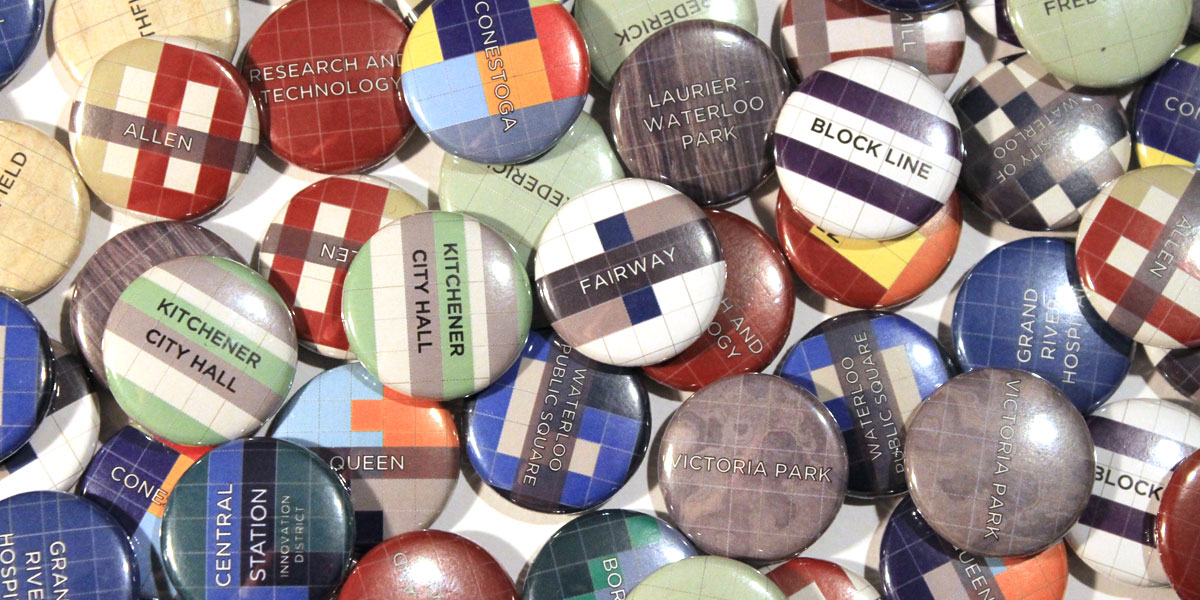
We’re creating buttons for each stop along the ION light rail route. Inspired by the anchor wall designs, these buttons will feature a unique pattern for each ION station, letting you show off your neighbourhood pride. We’re giving these buttons as ‘perks’ for your support of our Indiegogo campaign. You can get the whole set, or special collections featuring different neighbourhoods and places along ION.
We’re looking to raise $5,000 to continue TriTAG’s advocacy efforts through incorporation as a not-for-profit and better engagement with the Waterloo Region community.
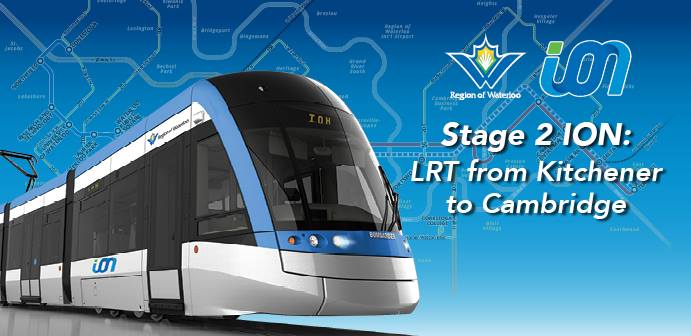
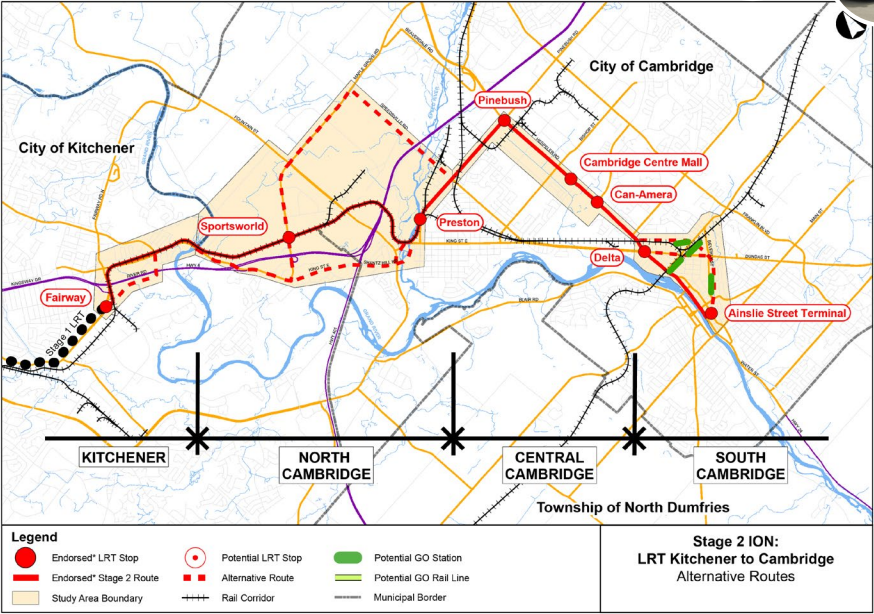
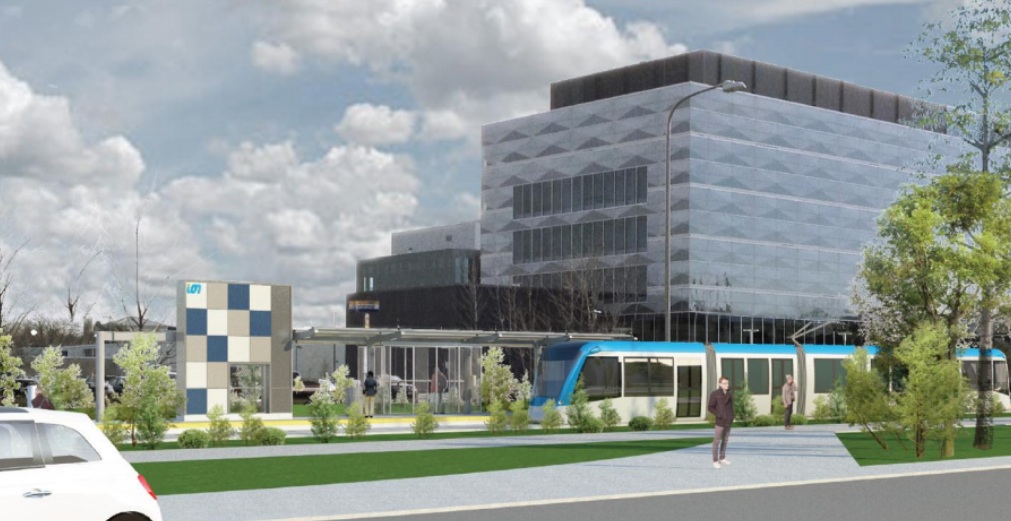
Help the Region of Waterloo plan Stage 2 of ION light rail from Kitchener to Cambridge. The Region is conducting a Transit Project Assessment and needs your opinions and input at two upcoming public consultations:
There are a handful of public meetings and input sessions coming up this month, for both Waterloo and Kitchener, as well as for rapid transit.
Columbia/Lexington
Lexington can be the most comfortable place to cross the Conestoga Parkway in Waterloo due to the lack of on/off ramps, but with four lanes and high traffic speeds, that’s not saying much. Fortunately, it looks as though the City is preparing to propose new cycling infrastructure on that corridor between King Street and Davenport.
UPDATE: A public drop-in consultation will be held next Wednesday June 3 from 6-8pm in Waterloo Mennonite Brethren Church. (Note: earlier, this meeting had been scheduled for May 13, but has since been moved.)
ION stop anchor wall designs
The Rapid Transit team has just unveiled designs for the anchor walls of ION stops – a 5 x 5 metre feature that will give each station a unique visual identity. (We’ve written before on the importance of stop design for wayfinding.) Two drop-in consultations are being held to gather public feedback on the designs: the first at Knox Church in Waterloo on May 20 from 3-8pm, and the second at Regional Headquarters in Kitchener on May 21 from 3-8pm. Comments can also be submitted online.
Kitchener Planning Around Rapid Transit Stations (PARTS)
Kitchener is developing plans to help guide growth around ION stop areas. On Tuesday May 26, they will be hosting a public information centre concerning the Central Station Areas Study. The meeting will be held from 6:30-8:30pm, in the Conestoga Room at City Hall, with a formal presentation at 6:45.
Uptown Streetscape
We’ve learned that the proposal for protected bike lanes on King Street in Uptown from Erb all the way to University is going to Waterloo City Council on May 25. Visit tritag.ca/bikeuptown to learn more, contact councillors, and spread the word about this important project.
Iron Horse Trail improvement strategy
The City of Kitchener is looking to make improvements along the Iron Horse Trail, and is hosting a series of input opportunities and meetings in late May and early June. These include a number of on-trail input stations, a workshop, and a public meeting. More details can be found on the City of Kitchener website.