GOing from Kitchener to London

The GO expansion project is bringing real passenger rail expansion across several existing GO lines in the Greater Golden Horseshoe. Southwestern Ontario, however, has not been included in these plans. London has the fifth largest metropolitan area in Ontario, with a population of 630,000, but has only 6 round trip trains to Toronto – a distance under 200km. VIA service levels remain lower than pre-pandemic; trips must often be planned around these infrequent schedules, making rail less competitive with driving.
In 2021, GO Transit launched a pilot project, extending the Kitchener line to London through Stratford. But the pilot was discontinued in 2023, and it showed that improvements in rail infrastructure are vital for the viability of regional rail expansion. The recent Stratford extension of the GO train has, however, raised hopes of further service improvements.
What’s clear is that London requires a more robust and reliable intercity transit connection, not only to support commuters but also to strengthen economic ties across the region. An upgraded line can be competitive with the busy Highway 401. Local business leaders, officials, and citizens have already repeated calls for more service along this corridor. This article will explore infrastructure improvements that can improve service between London, Kitchener, and Toronto.
Why not increase service to London with VIA?
London is already VIA’s fourth busiest station, with an annual ridership of about 500,000 pre-pandemic. London actually gets some of VIA’s most frequent service, including:
- 1 train a day to Sarnia
- 4 trains a day to Windsor
- 6 trains a day to Toronto of which
- 1 train is through Kitchener
- 5 trains are through Aldershot
These frequencies are, however, a far cry from what they were even 20 years ago. Despite major population and economic growth, service has declined. Furthermore, as track infrastructure was allowed to degrade, train speeds fell.

Why caused this reduction in speed and frequency? Why is it not expected to get better?
The Guelph Subdivision between London and Georgetown was under CN’s ownership and later leased to a small freight operator (Goderich-Exeter Railway) from 1996-2018. This short line railway had limited funds for maintenance, resulting in significant degradation of the track over the years. Freight service does not require high speed operation, meaning that there was little incentive for improvements. Proper upgrades can fix speed issues as demonstrated when Metrolinx bought the corridor from Kitchener to Georgetown in 2014. Travel times on the Kitchener line fell by 30 minutes and there are further plans to reduce Kitchener-Toronto travel times by 15%.
VIA Rail has historically suffered from a lack of interest from the federal government, despite citizen interest. VIA has seen a consistent reduction in passenger service since its inception in 1977 due to funding cuts, regardless of the government in power. Even routes in VIA’s busiest Windsor-Quebec City corridor were not spared. Due to the lack of dedicated VIA track and traffic from freight trains, VIA trains are routinely delayed by 30 minutes on the Sarnia-London-Kitchener-Toronto route.
Currently, VIA is in the process of replacing outdated HEP coaches (which are over 70 years old) and LRC coaches (which are 45 years old) with the brand new Siemens Ventures coaches and charger locomotives. However the new trains have encountered several teething issues which have caused operational constraints:
- VIA’s new fleet purchases were largely intended to replace existing equipment 1-to-1 but are not sufficient to meaningfully increase service.
- The new locomotives ingest too much snow in winter, which causes engine failure. This has caused extra locomotives to be added to trainsets for reliability.
- CN claims that the new trainsets have insufficient weight to be recognised by axle counters which signal the trains and control rail crossings. Trains must travel slower and this has forced VIA to increase the size of trains by adding extra coaches, so there are now fewer train sets available for additional frequencies.
Put together, VIA currently lacks sufficient rolling stock to meaningfully expand service. Federal focus has shifted to the proposed Alto High Speed Rail Project, leaving little political momentum for improvements on the existing corridor. As a result, significant service growth through VIA is unlikely in the near term.
What happened with the GO London pilot
The London GO pilot was introduced in October 2021, and was discontinued in October 2023. The pilot’s service did not set it up for success: there was a single round trip only on weekdays, with a 5am departure from London and a four-hour trip to Toronto's Union Station. With the provincial election occurring in October 2022, many people dismissed the pilot as an election gimmick. Some suggested this service was created to invalidate the idea of new trains in Ontario.
Correspondence with those more familiar with the situation paints a different picture. Metrolinx wanted to introduce a London-Kitchener-Toronto service but only after track speeds were improved. This was rushed, in part due to the 2022 election – and eventually it was decided that the GO pilot would occur before the infrastructure upgrades. We do note that there was an election promise by the current Ontario government to invest $160m to improve service on the London GO line:
“A re-elected PC government will invest an additional $160 million to improve the speed and frequency of all-new GO train service between London and Toronto.”
It is unclear if money was ever actually allocated for this purpose. Metrolinx planners were aware that slow and infrequent service would fail to attract significant ridership. They were, however, pleasantly surprised by Stratford ridership of 60 people/day for limited service offered in the midst of the pandemic.

The direct reason why the pilot ended was thus not due to low ridership (planners were aware that the pilot would not attract high ridership) but due to the reconstruction of platforms at London GO which saw the platforms being removed and resurfaced. This work occurred from October 2023 and was completed in October 2025. The current permanent Stratford GO service has been in the works since this time period. Metrolinx wanted to have a frequent London-Stratford-Kitchener bus until service was instated. Due to the ongoing GO bus shortage, they physically did not have enough buses for such a service. We do know that the current Stratford extension is meant to be permanent and there are some long term plans for future expansion to London although details are not known yet.
Why GO is well positioned to run London service
Residents may have reason to be disappointed in Metrolinx and GO Transit due to a lack of transparency and multiple missed deadlines on recent projects, but they remain the best positioned to improve service in Southwestern Ontario. While VIA offers more comfortable intercity style trains and slightly faster service, VIA has no capacity to conduct the infrastructure upgrades that are needed for any future service to be successful. Metrolinx and GO transit on the other have significant institutional capacity and political backing for expansion. Despite delays, plans like the Kitchener line expansion project have already resulted in numerous upgrades, such as double tracking for increased frequencies, and new, larger stations for increased capacity. Metrolinx has seen a virtuous cycle where improvements have resulted in increased ridership, which has resulted in residents more enthusiastic for service improvements. Metrolinx’s own ridership projections have often underestimated the popularity of their services: Kitchener station was supposed to see an average of 565 people per day by 2030 but is already seeing about 800 riders per day. Finally GO already owns most of the Kitchener-Toronto track and will own the whole corridor in the near future. London-Kitchener service is dependent on this track and operational decisions by Metrolinx will affect services anyway.
What infrastructure improvements are needed for a competitive service?
Some upgrades are needed before new service to London is launched. Rail infrastructure has historically been neglected until the last decade and outdated infrastructure will have to be rebuilt. Better infrastructure is needed for modern frequent and fast passenger rail than for slow and infrequent freight trains. Below we will briefly lay out what is roughly required for better service, with analysis based on current GO projects like all-day service to Kitchener. These upgrades won’t create high-speed rail, but they would deliver a big speed increase at a fraction of the cost and time.
1) General station improvements
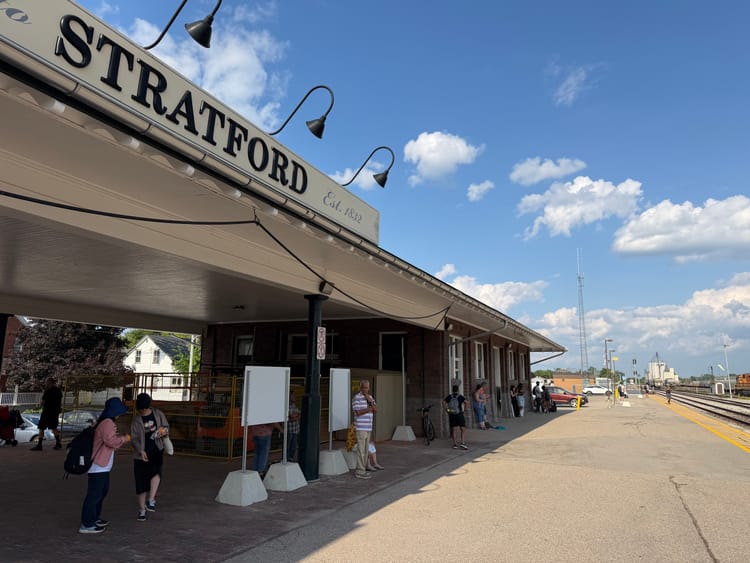
London, St Marys, and Stratford are the stations added to the GO Network. All Station buildings are currently owned by VIA. Minimal changes would be needed at London GO. However, the current stations and platforms at Stratford and St. Marys aren’t long enough to handle 12 car trains. In the case of St. Marys, only one car is able to use the platform. Platforms would have to be lengthened to fit 12 car GO trains (which are 330m long). A second platform at Stratford could help increase station capacity.
2) Track purchase from Kitchener to London
The quality of this track has degraded due to a lack of maintenance, as discussed above. This track does not have many freight movements despite being part of CN’s “mainline” (fewer than 5 trains per day). This, along with its passenger transportation significance, means that it makes sense for Metronlinx to justify a purchase of the track. Metrolinx/the province have previously purchased several hundred km of track from CN for passenger rail service improvements. For example, the Kitchener-Georgetown track (53km) was purchased in 2014 for $76 million. Earlier this year the province bought tracks from CN from Washago to North Bay (193km) for $138 Million. Considering those values, we could anticipate that purchasing the 94km of track could cost on the order of $100 million.
3) Improving track condition
Currently most of the London-Kitchener track has a 30mph (~50km/h) speed limit, with a segment from Stratford to New Hamburg being rated for 60mph (~100km/h). This has resulted in service from London to Kitchener taking 2 hours and 8 minutes alone by VIA rail. This is far slower than by automobile (1h 20min) and by intercity bus (1h 30m). What is disheartening is that up to 30 years ago the whole track had a 70mph limit. This meant that VIA train service was far faster than driving.

Simply fixing the existing tracks to allow for historical 70mph speeds (track class 4) would significantly improve travel times and allow for a London-Kitchener travel time of about an hour (Stratford-Kitchener travel time of 30min). Metrolinx restored the historic 70mph speeds for Kitchener-Georgetown service within 2 years of gaining control of that track section. Improvements would involve replacing rotten sleepers (the wooden part of a track), and ties and upgrading from older jointed rail (the source of the “clickety-clack” of old railways) to continuously welded rail.
4) Adding passing loops for increased frequency:
The whole line is single tracked. Similar to a one-way road, this means only one train per direction can use the track, which limits frequency. The addition of strategic double-tracked “passing loops” would allow for trains in opposite directions to pass each other without stopping, allowing for higher frequencies. Based on GO’s historical projects, passing loops every 10-15km are needed for two-way all-day hourly service. This means we would need 6 total passing loops (3 at the stations, and 3 equidistantly between stations).
5) Bridge work
Many of the bridges on the line have not been replaced/significantly repaired since the line was first built, meaning they are well over 100 years old! Most importantly the St. Marys viaduct near St. Marys station is not strong enough to carry most of GO’s locomotives. This bridge would need to be rebuilt to handle constant, regular service (similar to the Grand River Bridge in Kitchener). Other bridges would also need to be evaluated such as the Nith River Bridge in New Hamburg.
6) Yard improvements
There are no proper yards to store trains overnight and perform maintenance. This will become important once train frequencies increase. Yard space must be found close to Stratford and more importantly London stations. CN has major yards near those stations and an agreement should be reached to construct a GO-specific section. These stations have no way of externally powering locomotives overnight, unlike most GO maintenance facilities. “Shore power” facilities would need to be built to charge the equipment aboard and keep the trains active throughout the night when diesel engines are turned off. Without this, trains would have to idle 24/7 which is polluting and disruptive. (This is what happened during the London GO pilot.)
7) Upgraded signaling systems
On a positive note, the line does have an upgraded signalling system: the CTC signalling system added a decade ago courtesy of VIA from Silver (Georgetown) to Ashland (London). This work has reduced manual effort and has increased safety.

Figure 4: Simply fixing infrastructure to restore 1976 era service would be significant (source: Traingeek.ca)
8) New suburban stations:
Additional stations on the corridor between London and Kitchener could increase access to the line, thus increasing total ridership. However each additional station stop increases total travel time by ~2 minutes so we must be strategic with placement. We believe stations at suburban London, along with stations at New Hamburg-Baden, and Kitchener-Boardwalk would be beneficial. These stations should include 2 platforms, park-and-ride facilities that don’t fit downtown station locations, bus loops, and transit-oriented development from the start as with other Metrolinx station development. Further rationale for these stations is provided in the appendix of this article.
Future steps
Implementation
In our ideal scenario, service improvements would be done in two phases:
First, we would recommend service to Stratford to Kitchener be improved. Infrastructure is much less degraded in this section, and it would be cost effective to rebuild the infrastructure quickly. VIA is already faster (39m) than driving (44m) in this section. Stratford also had the bulk of the ridership of the pilot and has had impressive ridership in the new extension (around 300 passengers per trip on Weekends). When improvements take place, all Kitchener line trips can be extended to Kitchener with a reduced ~30 minute travel time. As improvements occur further along the Kitchener line, service from Stratford to Kitchener should increase to hourly service.
A second phase of work would include extending service from Stratford to London. Although the connection to London would result in much greater ridership, several costly but valuable necessary upgrades would be needed. Once upgrades are completed in this section, service from London to Kitchener would be hourly with a travel time of one hour. This would shave more than an hour from current travel times and be 20m faster than driving.
We recommended that formal planning for these improvements begins at the soonest possible time. This way by the time that Kitchener-Toronto hourly service commences, an hourly extension of service to London is possible, creating a unified London-Kitchener-Toronto line.

Starter bus service
Although train service is great, bus service is a critical stepping stone to quickly improve service and build ridership. TriTAG recently travelled by currently available buses along this corridor and summarized our findings.
To recap, Stratford-Kitchener and London-Stratford currently have service from PC Connect (Perth County transit). Although this is the most frequent option at 6 buses/day, buses have limited reliability and excessive stopping from passenger experience. We believe Metrolinx, Perth County, and Voyago (which manages the buses) should work together to boost frequency, speed and reliability of this service, targeting buses to sync with train times at Kitchener.
Between London and Kitchener, there are buses operated by private providers like Onex and Flixbus. Although these buses are comfortable, there are limited round trips for each service and stop locations aren’t always convenient. The province could encourage service improvements from these private providers as well.
We believe that the university market from Western to the University of Waterloo could be effectively served by a dedicated hourly GO bus. Due to the popularity of the London-Waterloo Fedbus route, we know there is latent demand for such a service.
Conclusion
Some of Ontario’s largest travel markets are in Southwestern Ontario. These have been traditionally underserved by passenger rail as VIA has faced consistent service reductions and track degradation has resulted in ballooned travel times. There is plenty of latent demand for better train service. GO is best equipped to lead service improvement with a long term extension of the Kitchener line west from Kitchener to London being the best choice. We believe that a 2 phase extension plan would be logical and service improvements should be coordinated with Kitchener line projects. Bus service should also complement rail improvements.
Regional rail across Southwestern Ontario would unlock major travel markets, and new GO lines could do this relatively easily and at a reasonable cost. Overall, we hope to see increased intercity travel options for millions of Southwestern Ontarians. We could have a real, fast alternative to driving in this corridor – we just have to implement it.
Appendix
I: How infrastructure affects service
Passenger rail authorities often don’t explain how infrastructure projects actually improve service capacity, leading to confusion amongst residents. Here’s a quick guide:
Table 1: Regional rail and intercity infrastructure and service improvements
Unfortunately, in a project such as GO expansion, infrastructure is often built according to convenience rather than true necessity. This means we have built certain infrastructure works that will not be used for over a decade. Meanwhile, service improvements are not possible as other more important works have not even started planning, let alone construction. For a potential London GO project we would encourage Metrolinx to commit to just the critical infrastructure upgrades that are needed for decent service, as we have outlined in our article.
II: Future station additions
Once we get London-Kitchener passenger rail running, several infill stations are good opportunities:
London Suburban
London is a large enough city with enough traffic that an additional suburban station makes sense to improve access to the line. We suggest one of two sites: a) Near the Fanshawe campus, with better urban connectivity and potential ridership or b) A site near London airport, which could have larger parking facilities.
New Hamburg-Baden
With a population of over 14,000, New Hamburg and Baden taken together are the largest community in southwestern Ontario where a VIA line runs through the town without stopping (bigger than St Marys and Acton which do have service). There is significant commuting traffic to urban Waterloo Region in this community. Though there is service from PC connect and GRT connecting to Kitchener, a GO station would better support the planned population growth in this area and help to make it more transit-oriented. We suggest one of two sites for a station: a) At Water street: This is where the original New Hamburg station was before being removed in the 1960s. This location is walkable to downtown New Hamburg, though there is not much room for much parking. b) A secondary location would be at Nafziger Road. In the original 2009 plan that brought us the Kitchener GO line, planners wanted to create a yard and station at this site, which would become the terminus for the line. However planners eventually decided to build the Kitchener Shirley yard instead and dropped the idea. This location is closer to Baden, has more space for parking and has the potential for a new transit oriented development (similar to Mount Pleasant Station). Many developments in the area highlight this future possible connection as do regional growth plans:

Kitchener Boardwalk
Like London, Kitchener is large enough to have an additional station. A station on the west end of the city would complement Breslau which is on the eastern side of town. This station would be located close to Glasgow Road and Ira Needles, was considered a desirable station in the 2009 Kitchener line extension plan, and has a significant amount of land owned by the Region of Waterloo and Enova Power (which is owned by local municipalities). The Boardwalk area is home to one of the largest bus terminals in Waterloo Region connecting 9 routes at a large commercial centre. While it is not on the ION phase 1 and 2 transit corridor, regional and provincial plans treat this location as a likely terminal of a future ION stage 3 service. Finally there are several significant residential developments proposed in the close vicinity of this location.
III: London-Toronto via Kitchener vs via Brantford
There are two VIA routes from London to Toronto: a) London-Brantford-Toronto and b) London-Kitchener-Toronto. Why are we interested in improving the latter (travel time 3h 19m) when travel speeds take much longer than the former (express 2h 10m, local 2h 30m)?
Of course TriTAG is based in Waterloo Region, and we’re interested in improved transit connections to and from Waterloo Region. That said, London, Stratford, Waterloo Region, Guelph, and Brampton have extensive education, healthcare and business ties. There is sufficient latent demand for an alternative to driving whether one is a Western student returning home to Guelph or a London resident working in downtown Kitchener. This demand is strong even ignoring the connectivity to Toronto. London and Waterloo Region have a combined population over a million people, and are the 4th and 5th largest metro areas in Ontario respectively.
Of course, the Hamilton region exceeds 800,000 (3rd largest metro), so the London-Kitchener and London-Hamilton markets are large enough that additional service to both corridors is warranted. The difference is that London-Kitchener is lightly used by freight trains and GO transit will own the Kitchener-Toronto corridor in the near future, making it ideal for a regional rail project.
While London-Hamilton-Toronto has high quality train tracks allowing faster service to Toronto, it is considered difficult to extend service due to Bayview Junction which is a major bottleneck for freight and passenger trains. Additionally, the track between Hamilton and London is heavily used by CN and is part of their mainline. In fact, Metrolinx's GO expansion proposals don't even have more than 2 trains per hour between Toronto and Hamilton due to these challenges.
Stratford itself is also a worthy connection. It has a growing tourist demand from the Stratford Festival, has a University of Waterloo Campus, and has commuters to both Waterloo Region and London. All these help justify GO for a town of 33,000 residents. The local transit system (Stratford Transit) has a bus to Stratford station every half hour, impressive for a town of this size.

![[Updated] Is Greyhound pulling an Uber?](/content/images/size/w750/jekyll-import/greyhound_bus.jpg)